
A factory can have hot exhaust, warm process water and a substantial energy bill without having an immediately viable heat-recovery project. The missing question is often simple: where can that heat be used, at the right time and under acceptable operating conditions?
For plant managers, project engineers and procurement teams, the first useful deliverable is therefore a feasibility brief. It connects an identified heat source to a genuine heating requirement and records what must be measured before an equipment proposal becomes meaningful.
This guide offers a practical way to prepare that brief. It is a planning framework, not a thermal design calculation or a promise of a particular percentage saving. Final selection requires competent engineering review using verified site data.
Quick answer: Start by matching a heat source with a useful demand. Document temperature and flow conditions, operating schedules, contamination constraints, connection routes, controls, maintenance access and the complete installed scope. Treat unmeasured assumptions as questions to resolve.
Define the problem you want the project to solve
Begin with one specific objective. Are you investigating preheating a process stream, reducing a particular utility demand or making better use of energy already leaving an operation? A statement such as “reduce factory energy consumption” is too broad to support an initial quotation.
Identify the process owner and the boundary of the study. Record which production line, operating mode and utility connection are included. Also state which neighbouring systems are excluded for now. A defined boundary helps the team distinguish an initial opportunity from a plant-wide redesign.
Write the objective in operational language. “Investigate whether this outgoing stream can support this recurring heating duty” is more useful than “supply an energy-saving unit.” It invites the engineering team to evaluate the application rather than select equipment before the problem is understood.
Describe the heat source as it actually operates
List the source stream, its composition, normal operating condition and the range of conditions that occur in practice. Distinguish measured information from estimates. Include where and when each measurement was taken and who can explain the production context.
Avoid relying only on a nameplate or one unusually favourable reading. A measurement taken during a peak batch may not represent the rest of the shift. Ask the process team which operating states need to be observed and whether existing instruments provide usable records.
Have qualified personnel plan any additional measurement work. A feasibility exercise should not encourage improvised access to hot, pressurised or hazardous systems. Document missing data and obtain it through the site's approved engineering and safety procedures.
Identify a real use for the recovered heat
A heat source becomes a more useful project candidate when there is an identifiable demand. Describe the receiving process, its required operating conditions and the periods during which it needs heat. Name the person responsible for confirming those requirements.
Ask whether the receiving process can accept variation or needs a tightly controlled supply. Also identify the existing source of heat and the service it provides. The recovery concept must be evaluated within the receiving operation's quality and reliability needs.
Do not assume that every nearby tank or pipeline is a suitable destination. An engineering review must establish whether the temperature relationship, fluid compatibility and process requirements support the proposed transfer. Physical proximity alone does not establish feasibility.
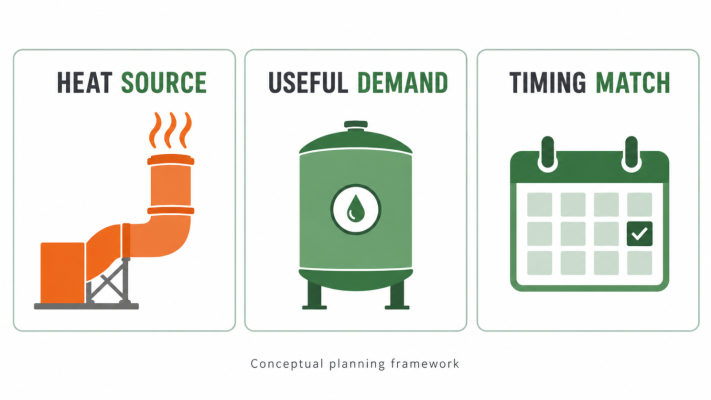
Match the operating schedules
Put the source and demand schedules beside each other. Note normal shifts, batch durations, cleaning periods, shutdowns, seasonal changes and exceptional operating modes. A weekly schedule can reveal a mismatch that is not visible in an equipment photograph.
For example, a source may be available during production while the proposed demand occurs mainly before production starts. That does not automatically rule out a project, but it changes the questions. Storage, alternative demand or a different recovery arrangement would require further assessment.
Keep the first schedule simple enough for operators to review. Ask them to mark the periods when the initial assumptions are wrong. Their practical knowledge can prevent a study from treating an intermittent opportunity as a continuous one.
Look beyond the recovery unit
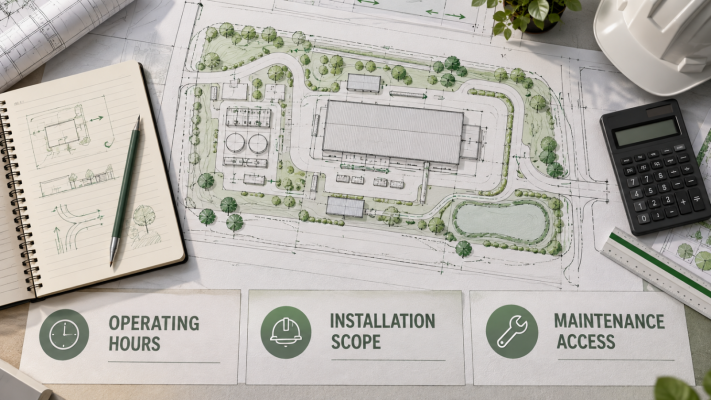
The physical route between source and demand affects the project scope. Prepare a preliminary site layout showing possible connection points, distances, obstacles and areas requiring access. Mark uncertainty clearly rather than presenting a sketch as an approved installation drawing.
List interfaces with existing services. These may include electrical supply, instrumentation, controls, structural support, drainage or other site provisions, depending on the application. Ask the responsible engineering disciplines to confirm what needs inclusion.
A quotation for the central item of equipment is not automatically a quotation for the installed system. Make the boundary explicit: design, supply, transport, installation, testing, commissioning and ongoing support may be separate responsibilities. Compare offers only after those boundaries are understood.
Put contamination and process integrity in the brief
Describe what must remain separated and what the consequences of an unintended interaction could be. Product quality, water chemistry, process cleanliness and materials compatibility may all be relevant. The appropriate safeguards depend on the actual application.
Provide available fluid information and identify uncertainties for specialist review. Do not describe a stream merely as “water” when its chemistry or contamination could affect the design. Likewise, record whether properties change across operating modes.
These details help the engineering team assess suitable arrangements and maintenance needs. They are not an invitation to choose materials from a generic table. Application-specific compatibility and risk assessment remain part of the professional design process.
Use established guidance to frame the investigation
The U.S. Department of Energy's steam-systems resources treat energy improvement as a systems issue and provide assessment tools and technical references for different opportunities. This is a useful reminder to examine the surrounding process rather than judge a recovery device in isolation.
Its steam-boiler management guidance also explains the value of returning suitable hot condensate: water already carrying heat needs less additional heating than colder make-up water. The same resource discusses professional assessment and lifecycle considerations.
These references provide background, not a design approval for an Indian plant. Local requirements, site conditions, applicable codes and the selected equipment's operating limits must be established for the actual project. Do not transfer a case-study saving from another facility into your business case.

A fictional feasibility review that changes the question
Consider a fictional manufacturing plant that wants to recover heat from an outgoing process stream. Its first enquiry asks for an exchanger based on a single temperature measurement and the approximate size of a nearby water tank.
During a preliminary review, the team discovers that the outgoing stream and the tank's heating demand do not consistently operate together. Maintenance also points out that the proposed equipment position would obstruct an existing service route. Neither issue was visible in the original request.
The team revises the brief. It records operating schedules, considers a different receiving duty and includes access requirements in the layout review. The outcome is a better-defined study, not an asserted energy saving. This example is fictional and does not describe a GI Equipments installation or customer result.
Planning principle: A useful feasibility study can improve the question before it recommends the equipment.
Build an honest financial model
Ask the project team to show the assumptions behind any saving estimate. The model should identify the energy or utility being displaced, the operating periods assumed and the costs included. Separate measured inputs from estimates and proposed future conditions.
Include the installed scope and relevant operating costs in the review. A lower equipment purchase price may not represent the lowest overall project cost. The comparison should consider the responsibilities and service requirements that have been identified for the application.
Test the case under less favourable assumptions. What happens if operating hours are lower, the useful demand changes or the installation scope increases? This is a decision aid, not a reason to invent a precise payback period before the underlying data is available.
Plan maintenance and verification before purchase
Ask how the proposed system will be inspected, isolated and maintained under approved site procedures. Identify the access, lifting, cleaning or replacement provisions that the selected design may require. Have the maintenance team review the layout before it is finalised.
Also agree how the project will be evaluated after commissioning. Define the measurements, operating conditions and comparison method that will support a meaningful review. A before-and-after bill alone can be difficult to interpret if production conditions have changed substantially.
Record who will own the operating data and who will investigate unexpected performance. A recovery project continues after installation. Clear responsibilities make it easier to distinguish an equipment issue from a change in the process it serves.
What to include in the first feasibility pack
- A specific objective and the boundary of the study.
- Source-stream details, operating ranges and measurement dates.
- Receiving-process requirements and responsible contacts.
- Source and demand schedules, including interruptions.
- Available fluid information and separation requirements.
- A preliminary layout with connection and access constraints.
- Interfaces with utilities, controls and existing equipment.
- Proposed supply and installation responsibilities.
- Financial assumptions and unresolved data needs.
- Maintenance and post-commissioning verification questions.
The pack does not have to be perfect before a discussion begins. Its value comes from making uncertainty visible. A clearly labelled estimate is more useful than an apparently precise value that nobody can trace to a measurement or responsible source.
Frequently asked questions
Does a hot outlet automatically justify heat recovery?
No. A useful demand, compatible operating conditions and a practical system arrangement must also be assessed. Temperature alone does not describe the full opportunity.
Should I select a heat exchanger before preparing the brief?
An early technical discussion can help identify missing information, but final selection should follow verified application requirements. Avoid making the product choice the starting assumption.
Can another factory's payback period be used for my project?
Treat it as background only. Your operating schedule, utility costs, installation scope and process requirements may differ. Build the business case from the relevant site inputs.
Who should join the first review?
Include the process owner, maintenance, utilities, project engineering and procurement as appropriate. Bring in the relevant safety and specialist engineering functions for the application.
Start the conversation with a usable brief
A good waste-heat recovery enquiry links a defined source to a defined need and makes the operating assumptions visible. It gives equipment suppliers and plant teams a sounder basis for discussing the next engineering step.
Contact GI Equipments with your application outline, available process data and installation constraints. Ask what additional information is required before a technically appropriate proposal can be developed. Clear inputs make the discussion more productive and the eventual scope easier to review.