
A mixing job does not always need a rotating shaft
Two liquids enter the same pipe. That does not necessarily mean they leave as a uniform mixture. One stream may remain concentrated near the wall, a small additive may travel unevenly, or a sample taken from one point may hide what is happening across the pipe.
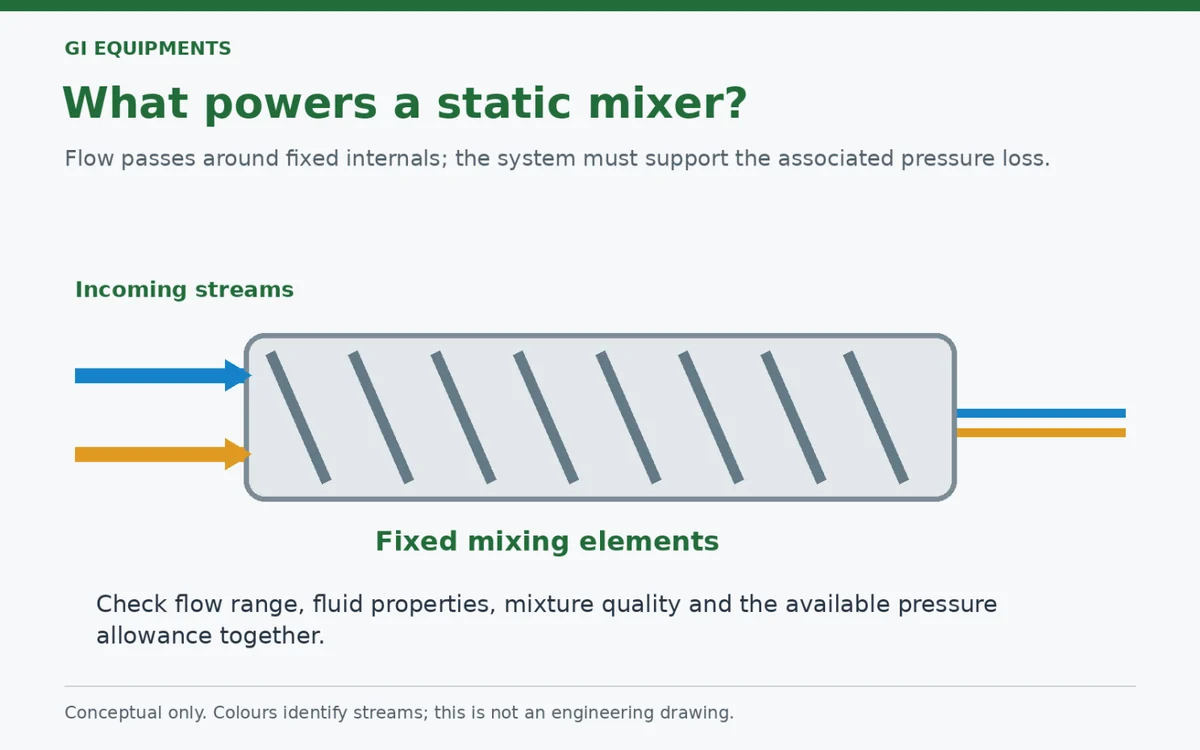
A static mixer addresses this problem with fixed elements inside a flow passage. There is no motor driving those elements. The moving fluid supplies the energy as it passes through the mixer, with an associated pressure loss. That distinction explains both the appeal of static mixing and the questions a buyer should ask.
For a plant team sourcing process equipment in Chennai, Ambattur or elsewhere in Tamil Nadu, the right starting point is the mixing duty. Pipe size alone cannot establish whether a mixer will deliver the result your process needs.
The useful question is: “What must be uniform, where must it be uniform, and under which operating conditions?”
What happens inside a static mixer?
Stationary elements redirect the flowing material. Depending on the design and flow conditions, they can divide and rearrange streams, promote exchange across the pipe, or create the conditions needed for dispersion. Different geometries serve different duties. A device intended for turbulent water blending is not automatically suitable for a highly viscous product.
Sulzer describes static mixers as tubular internals that produce mixing and dispersion effects while fluid flows around motionless parts. NOV's Kenics range likewise includes designs for different flow regimes and applications. These are useful reminders that “static mixer” is a category of equipment, rather than a single interchangeable construction.
Do not confuse a drawing of a helical element with a performance specification. The internal geometry, length, diameter, injection arrangement and operating conditions work together. A visually similar assembly can behave differently in a different process.
Where can this approach be useful?
Typical discussions include blending compatible liquids in a continuous line, distributing a small additive into a larger flow, and bringing a stream toward a more consistent composition before a downstream operation. Specialist designs also address dispersion, gas-liquid contacting and other duties. Each application needs its own assessment.
Begin by naming the actual task. “Mix an additive into the carrier stream” is a better brief than “supply a mixer.” Then explain why the result matters. Is a downstream instrument giving variable readings? Does the next operation need a defined concentration? Does product quality depend on consistency at a particular location?
Static mixing does not automatically replace a vessel that provides storage, batch holding, reaction time or solids suspension. Those functions may still be required. A plant can need both an inline mixer and a tank because the two items perform different jobs.
The missing figure in many enquiries: minimum flow
Purchase enquiries often contain the maximum production rate. The minimum and normal rates can be just as important. A line may operate at reduced output during startup, a small order or a seasonal demand change. The mixer must be assessed against the operating range that matters to the process.
Provide the flow range for every relevant stream. If the additive flow changes independently of the main flow, describe those combinations rather than supplying one average dosing ratio. Also identify whether flow is continuous, intermittent or strongly variable.
Ask the supplier to state the conditions covered by its proposal. A result established at one operating point should not quietly become a promise for every possible flow. Where a boundary remains uncertain, identify the evidence needed to resolve it before purchase.
Describe the fluids as they will actually arrive
Temperature, viscosity, density, composition and the presence of solids affect the design conversation. A product name alone may not communicate those properties. Even the same product can behave differently at different temperatures or concentrations.
Share representative property information with its source and operating temperature. Tell the supplier which values are measured, estimated or still awaiting confirmation. Include compatibility requirements for wetted materials, seals and connections, together with the applicable process hazards.
For shear-sensitive materials, discuss what the product can tolerate. For fluids that react, set or foul when combined, involve the responsible process and safety specialists. The mixer cannot be selected independently of the consequences of bringing those materials together.
No motor does not mean no energy cost
The pressure available in the line helps drive fluid through the mixer. The pump or wider system must support the required flow and the additional resistance. A motionless internal assembly therefore should not be sold or purchased on the assumption that mixing energy is free.
Request the predicted pressure loss over the relevant operating range and ask the plant engineer to check it against the complete system. Include existing pipework, valves, filters and other equipment. The acceptable loss is a process decision, rather than a universal number for every plant.
Pressure loss and mixture quality also need separate acceptance criteria. Statiflo's specification guidance asks buyers to define the quality of mixing and the downstream location where it must be achieved. A pressure reading alone cannot demonstrate the required composition uniformity.
Agree what a successful mixture looks like
“Good mixing” is difficult to approve objectively. Define the relevant property, the acceptable variation, the sampling or measurement method, and the location of assessment. Ask whether the proposed evidence represents the whole flow or only a convenient sampling point.
For some duties, the supplier may support the proposal with established design information, modelling, trials or a combination. Ask what the evidence covers and which assumptions remain. A simulation is useful when its inputs and limits are understood; an attractive flow image on its own is not an acceptance test.
Keep the performance requirement proportionate to the process. Unnecessary precision can add cost and complicate verification. Insufficient precision can leave the buyer and supplier disagreeing after installation about whether the equipment works.
An illustrative plant decision
Consider a hypothetical water-processing line in Chennai. The team wants to distribute a small liquid addition before a downstream measurement point. An enquiry initially specifies only the pipe diameter and peak flow. This example is fictional and does not describe a GI Equipments customer project.
During review, the team adds two overlooked conditions: the line regularly runs at reduced output, and the additive enters through an existing connection whose position was never reviewed for this duty. The buyer now has a more useful question than which mixer is cheapest.
The revised enquiry asks for an assessment across the actual flow range, an appropriate injection arrangement, a defined downstream assessment location, and the pressure-loss information needed for a pump-system check. The team agrees who will evaluate the mixture and how the result will be recorded.
The lesson is a purchasing one. Better input data turns an equipment quotation into a proposal that can be evaluated against a real operating requirement. It does not guarantee a particular outcome or remove the need for engineering review.
Think about the installed line
Discuss available space, access, orientation, supports, connections and any removable components with the responsible designer. The supplier needs to understand the actual installation, including nearby dosing points, instruments and changes in the flow path.
Cleaning and inspection should be part of that discussion. Ask how retained material will be addressed, what access is needed, and whether the proposed construction suits the plant's cleaning approach. No moving parts does not mean no inspection, cleaning or maintenance obligations.
Record the equipment identity, materials, approved arrangement and operating limits in the handover pack. If the process later changes, those records give the team a starting point for reassessment instead of treating the original mixer as suitable by default.
A short enquiry that saves a longer argument
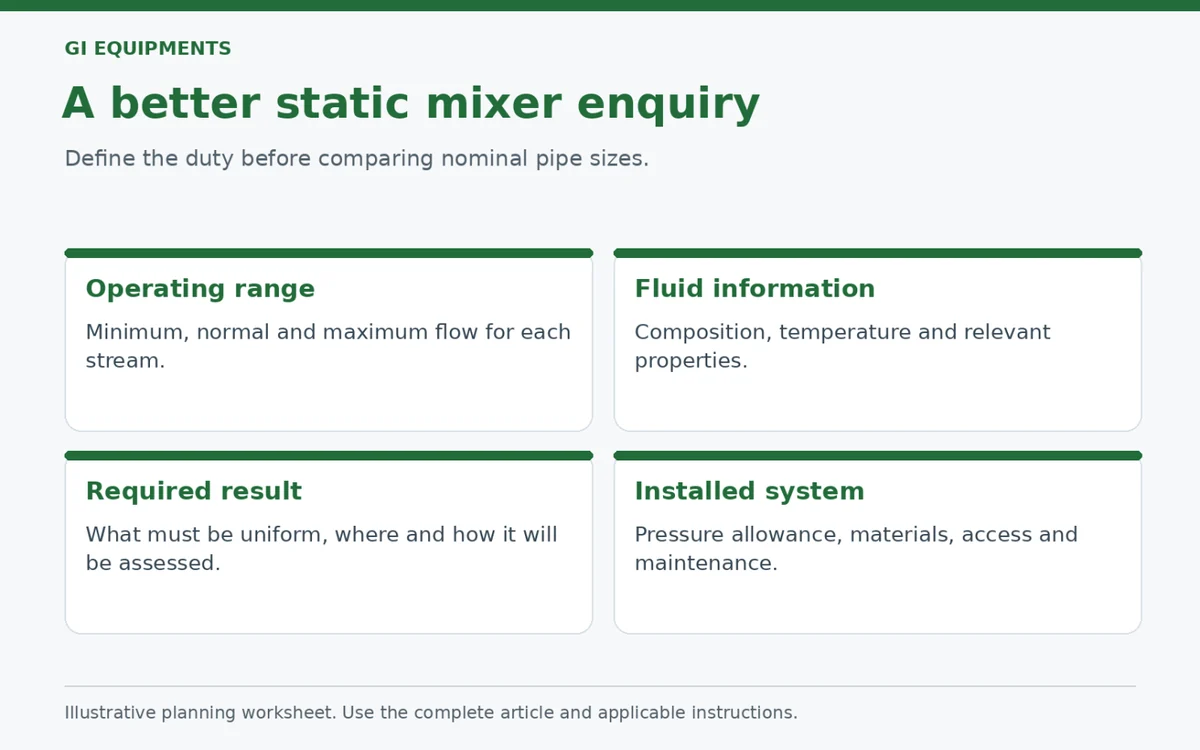
Before requesting a static mixer quotation, prepare these details:
- The mixing objective and the downstream operation it supports.
- Minimum, normal and maximum flow for each stream.
- Relevant fluid properties, temperatures and composition ranges.
- Wetted-material and process-safety requirements.
- The available pressure-loss allowance, subject to system review.
- The proposed injection and installation arrangement.
- The mixture-quality requirement and assessment location.
- Cleaning, inspection and documentation expectations.
Ask the supplier to identify missing information rather than filling gaps with unrecorded assumptions. Keep exceptions visible in the technical comparison, even when two quotations have the same nominal pipe size.
Three questions buyers often ask
Will a static mixer work at every flow rate? Its performance must be assessed over the specified operating range. Do not infer a full-range result from a single design point.
Can we choose it using pipe diameter alone? Diameter is only one input. The duty, fluids, flow range, pressure allowance and required result also matter.
Is it maintenance-free? Fixed elements avoid a rotating drive within the mixer, but the installed equipment still needs an appropriate inspection, cleaning and maintenance plan.
GI Equipments includes static mixers within its process-equipment offering. For a project discussion, bring your operating data and mixing objective to the team in Ambattur, Chennai. A clear brief helps establish what can be proposed, what needs checking and how a future supply decision will be judged.
www.giequip.in | +91 99432 03334
Sources and further reading