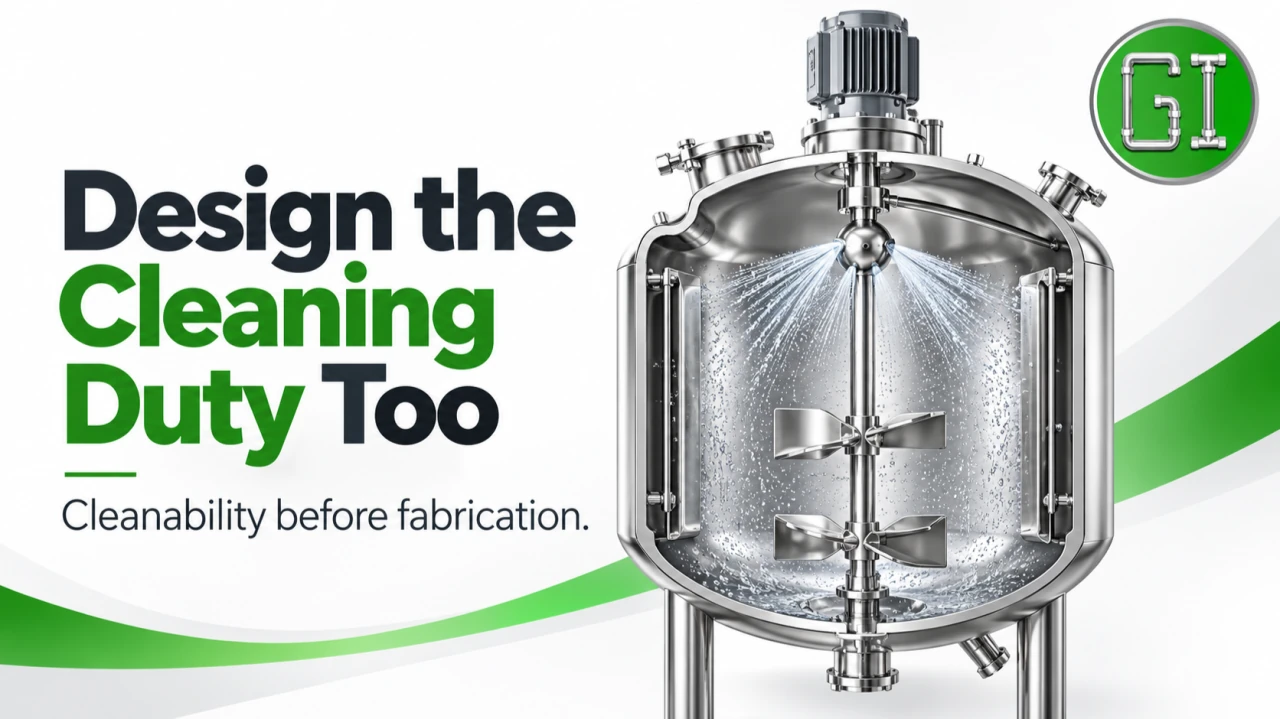
Give cleaning a place in the design discussion
A process vessel can meet its capacity requirement and still create a difficult changeover. Product remains beneath an internal component. Rinse liquid collects in a pocket. A cleaning connection is present, but no one has agreed how the return will be monitored. These questions are much easier to address while the design is being reviewed than after the equipment is installed.
Cleanability deserves its own discussion alongside production performance. For plant owners and project teams, that means describing what will be removed, how it will be removed, and what evidence will allow the equipment to return to service. “Easy to clean” is a useful ambition, but it is not a sufficiently clear requirement for fabrication.
This guide concerns the practical design conversation for process equipment. Food, chemical, pharmaceutical and other operations have different hazards and quality requirements. The examples are questions to resolve with the responsible engineers and process owners, not a universal cleaning recipe or a claim that one equipment design fits every industry.
Key takeaways
Define the residue and required outcome before choosing the cleaning arrangement. Review coverage, drainage, materials and the complete return path together.
Distinguish a design review, a cleaning-coverage check and process-specific verification. Avoid relying on routine vessel entry to compensate for unresolved design questions.
Start with the residue and the next product
Write a short description of the residue the cleaning system must handle. Include whether it is wet, dry, sticky, soluble, abrasive or likely to harden during an extended hold. Describe the longest realistic production run and the delay that could occur before cleaning begins. A freshly emptied demonstration vessel may not represent the difficult condition the plant eventually faces.
Then describe the next use of the equipment. Is the same product returning, or does the next batch have a different colour, odour or composition? What carryover could affect quality? Ask the quality and process teams to define the relevant acceptance criteria rather than assuming that a surface which looks clean is suitable for release.
Tetra Pak’s Dairy Processing Handbook distinguishes different meanings of cleanliness and explains that soil characteristics affect cleaning. Its dairy-specific examples should not become default recipes for unrelated processes. The transferable question is simple: what are we trying to remove, from which surfaces, and how will we know enough has been removed?
Choose the cleaning approach before fixing the geometry
Discuss whether the duty calls for cleaning in place, removal of components for cleaning, dry cleaning or a controlled combination. The equipment layout should support the intended approach. A design that assumes circulation through the equipment needs different interfaces from one that relies on removing and cleaning individual parts.
Do not add water to a dry-process brief merely because wet cleaning sounds more thorough. The product, materials, dust hazards and drying requirements need their own assessment. EHEDG’s guideline catalogue separates guidance for wet-cleaned open equipment, closed liquid-processing equipment and dry particulate processes. That distinction is a useful reminder to select the relevant design framework rather than copying a familiar arrangement.
Ask which parts are excluded from the main cleaning cycle. Seals, sample points, removable tools and external product-contact components can be overlooked when the discussion concentrates on the main shell. For every excluded part, identify the separate method, the responsible person and the route back to an acceptable assembled condition.
Follow the liquid all the way out
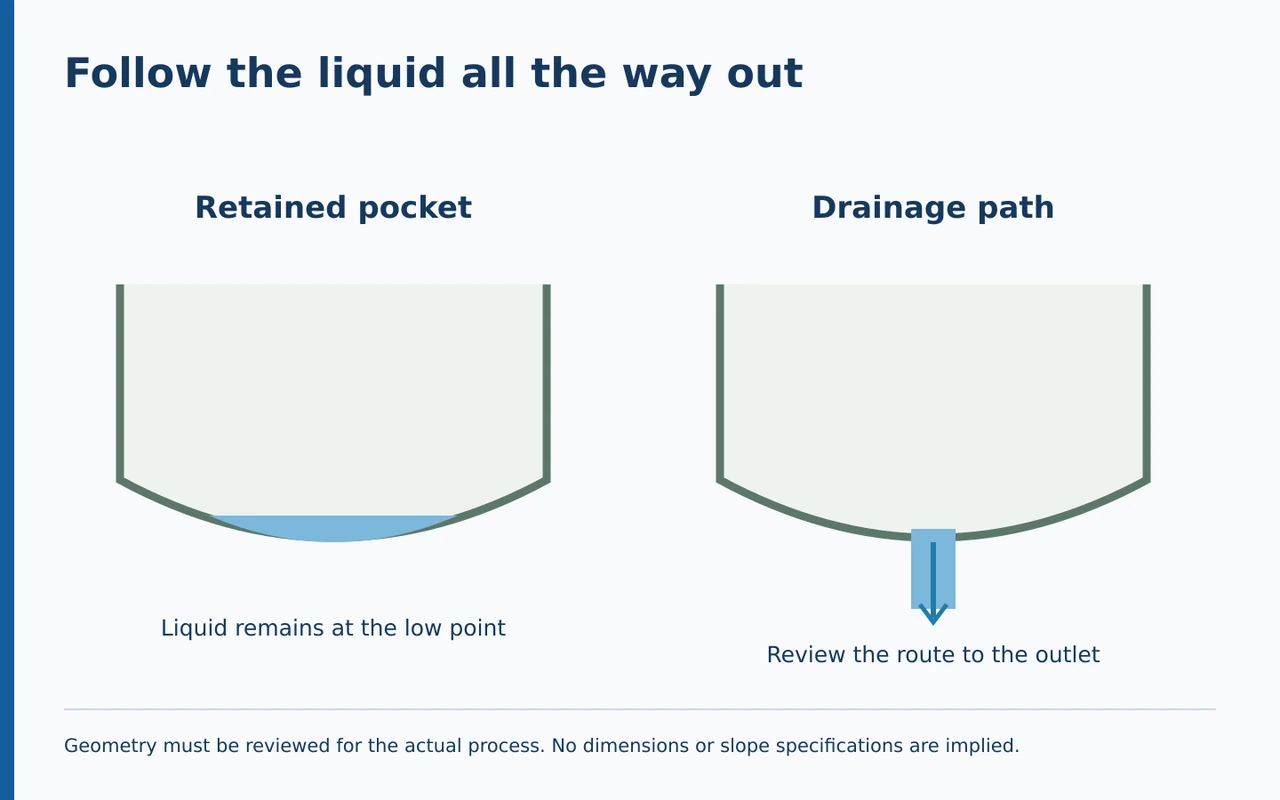
On a drawing, trace the intended path of product removal, cleaning solution and final rinse. Ask the designer to identify low points, retained pockets and places that need a separate drain. Include attached valves and short connecting sections rather than stopping the review at the equipment nozzle.
The word “drainable” needs context. Agree the installed orientation, the condition of the relevant valves and what residual hold-up is acceptable for the actual duty. A component can look satisfactory on an isolated drawing yet create a pocket after connection to surrounding pipework. Review the assembled arrangement and ask who owns this interface.
Where liquid retention matters, decide how it will be checked. A suitable observation or test can be specified during the project, with its conditions recorded. Do not assume that an empty-looking vessel demonstrates that every concealed connection has drained. Equally, avoid imposing an arbitrary drainage number without explaining the process requirement it is intended to protect.
Check what the cleaning device cannot see
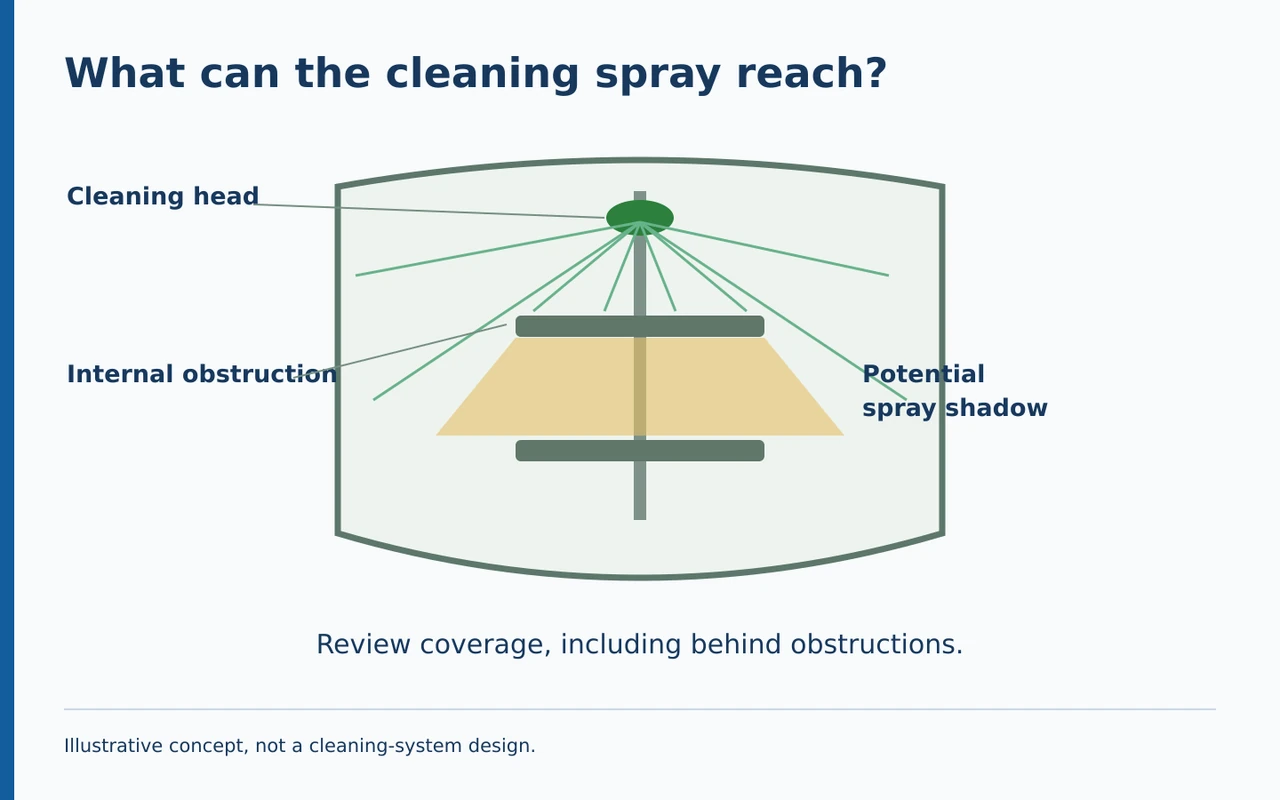
A spray device has to work around real internals. Agitator blades, baffles, probes and other obstructions should appear in the cleaning-coverage review. Ask what happens underneath and behind them, and whether their operating or resting positions affect coverage. The presence of a top cleaning connection alone does not answer those questions.
Alfa Laval describes an ice-cream producer’s difficulty cleaning beneath complex agitators in a published technical story. The relevance here is the demonstrated possibility of spray shadows, not a promise that the same hardware or result applies to another plant. Any proposed solution needs assessment against the vessel geometry and residue in question.
Request a clear explanation of the proposed coverage evidence. A drawing or simulation may support design review; a coverage test may answer a different question; a process-specific cleaning assessment must establish the required result. State which question each piece of evidence answers so a visually persuasive diagram does not become a substitute for verification.
Review surfaces, joints and materials together
Ask the fabricator how product-contact joints, internal transitions and attachments will be finished and inspected for the agreed application. Discuss locations that may retain residue or be difficult to inspect. Keep the acceptance language specific enough that the supplier and the plant team can recognise the same result.
Avoid reducing cleanability to a single surface-finish number. The purchasing team should understand which surfaces the requirement covers, how it will be checked and what geometric features remain important. A polished area does not resolve an inaccessible pocket elsewhere. Conversely, an unnecessarily demanding finish should not be specified without a process or quality reason.
Review the cleaning exposure as well as the production exposure when selecting materials, seals and linings. Ask for compatibility assessment against the actual proposed chemicals, concentrations, temperatures and contact times. Do not infer compatibility from “stainless steel” or a generic seal description. Record the agreed operating envelope and require review if the cleaning method later changes.
Design the whole cleaning circuit
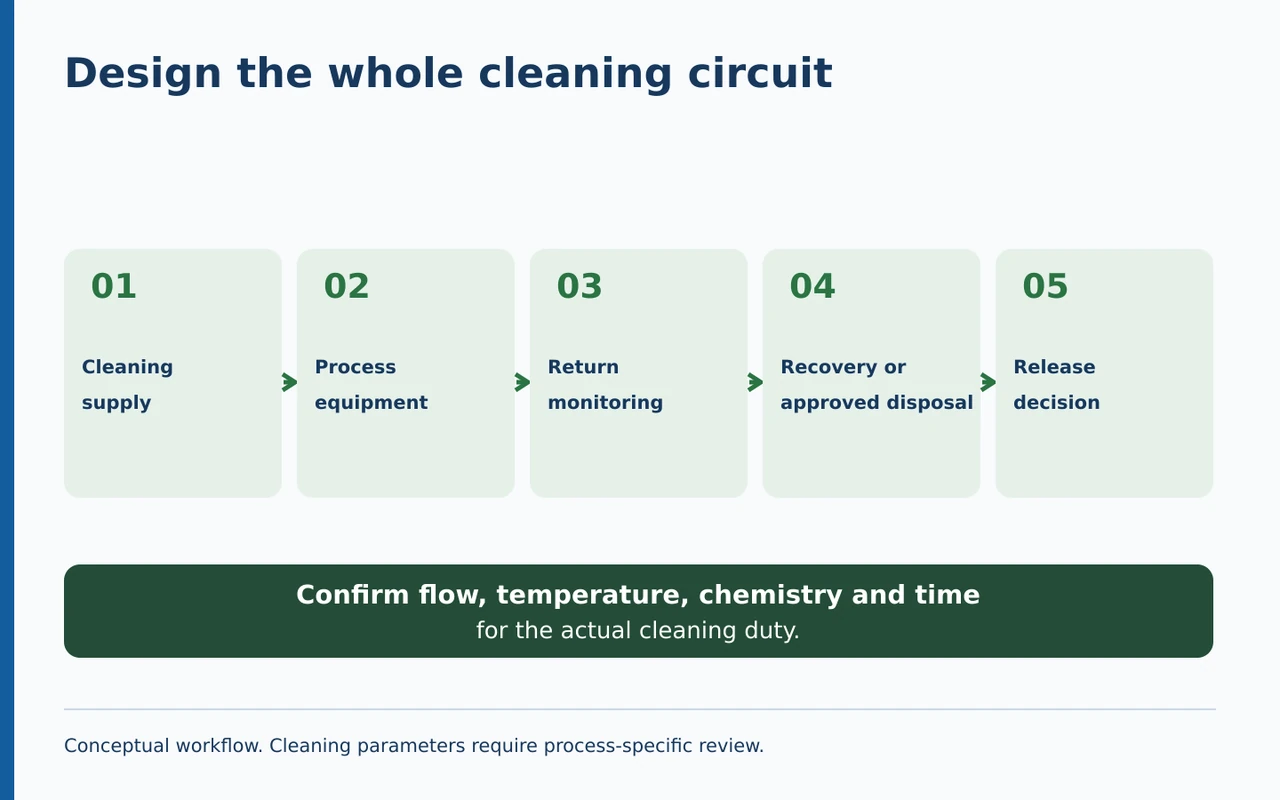
The discussion should extend from the cleaning supply to the return and its destination. Identify available utilities, the relevant measurement points and what the operator will see during the cycle. Ask whether the plant can deliver the conditions assumed by the equipment proposal, particularly when several users share the same utilities.
Tetra Pak identifies concentration, temperature, mechanical effect and time as important cleaning variables. For a specific project, the responsible team must determine the appropriate combination and how it will be controlled. A supply reading alone may not describe the conditions at the surface being cleaned. Ask where measurements are taken and what they establish.
Include residue recovery, rinsing, waste segregation and the approved effluent route in the review. Where a recovery arrangement is proposed, confirm its intended use and acceptance requirements. Do not assume that every liquid can be returned to production or sent to the same drain. Give the cleaning cycle a defined endpoint and a clear release decision.
Avoid designing routine entry into the job
Before accepting a method that depends on someone entering a vessel, ask whether cleaning and inspection can be completed from outside. Consider the equipment features and viewing or inspection methods needed to support that approach. An opening large enough for a person does not make entry an acceptable routine solution.
The UK Health and Safety Executive advises avoiding confined-space work where possible and requiring risk assessment and appropriate controls where entry is necessary. This is useful safety guidance, not a statement of Indian legal compliance. The plant must apply the laws, procedures and competent assessment relevant to its own site.
Keep that distinction visible during procurement. “The operator can reach in” is not a completed safety review. Isolation, hazardous residues, moving equipment and other site-specific risks need proper assessment. Do not turn a cleanability article into an entry procedure; resolve the access strategy with the responsible safety and engineering teams.
Agree what the evidence will and will not prove
Separate three questions: does the equipment match the agreed design, does the cleaning arrangement function as intended, and does the actual cleaning process achieve the required result for this application? The evidence for one question should not automatically be used to answer the others.
EHEDG explicitly states that its hygienic and aseptic suitability test methods are not intended to demonstrate performance in every specific application. The food manufacturer remains responsible for developing appropriate cleaning regimes. That is an important boundary when discussing any certificate, supplier demonstration or standardised test: understand its scope before relying on it.
For the project, agree the relevant checks, records and release responsibilities before fabrication. Identify which reviews can happen on drawings, which need the completed equipment, and which depend on installation and the actual process. Leave no ambiguity about who resolves a failed check or an excluded component. This turns cleanability from a general claim into a reviewable requirement.
A hypothetical mixing-vessel design review
Imagine a plant procuring a mixing vessel for products that leave a sticky residue. The initial brief lists capacity, temperature and material. During review, the production team adds an overnight hold scenario, while quality identifies the next product as sensitive to carryover. Those additions change the cleaning questions without changing the nominal vessel capacity.
The team then marks the underside of the agitator and a low connection as areas needing closer review. The supplier explains the proposed coverage and drainage arrangement, and both sides agree what evidence will be needed. Utilities confirms the conditions available at the cleaning supply, while the site team assigns the return and waste-handling interfaces.
This is a hypothetical planning example, not a GI Equipments case study. Its value is the sequence: define the difficult duty, examine the assembled geometry, agree the method and specify the verification. No cleaning-time reduction or resource saving should be claimed until the completed arrangement has been evaluated under the relevant conditions.
Quick questions before acting
Does a cleaning connection make equipment cleanable? It provides an interface, but the method still needs to address actual residues, geometry and operating conditions.
Does a supplier test remove the need for plant verification? Understand the test scope. Application-specific release requirements remain a separate responsibility.
Who should join the review? Bring the process owner, operations, quality, safety, utilities and fabricator into the relevant decisions, with one person coordinating unresolved interfaces.
Bring a clearer brief to the fabricator
A useful cleanability brief can be concise. It should identify the residue, worst credible hold condition, cleaning approach, excluded parts, utility constraints and acceptance responsibility. Attach the relevant process information rather than filling the enquiry with general phrases such as “hygienic,” “maintenance friendly” or “fully cleanable.”
For equipment projects in Chennai and other industrial locations, these questions bring operations, quality, safety and fabrication into the same discussion early. The aim is to resolve foreseeable cleaning difficulties before they become permanent features of the plant.
Preparing a process-equipment enquiry? Share the production duty and the cleaning requirements with GI Equipments so both can be considered in the fabrication discussion.
Sources and further reading