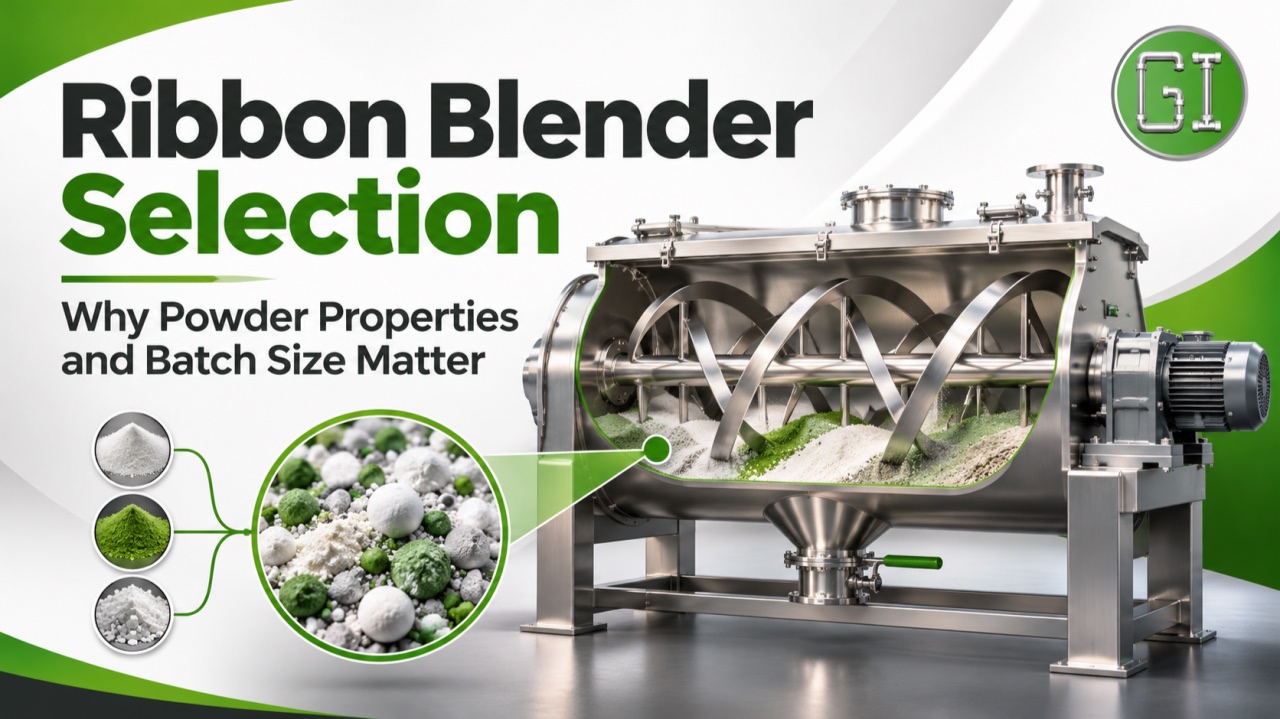
“We need a blender for a 500-kilogram batch.” It sounds like a clear enquiry. Yet one important detail is missing: 500 kilograms of what?
A light powder and a dense granular material can occupy very different volumes at the same weight. Their behaviour during loading, mixing and discharge may also differ. Selecting a ribbon blender from batch weight alone can therefore leave the buyer comparing machines that are not designed for the same duty.
For manufacturers planning powder-handling equipment in Chennai or elsewhere in India, the best starting point is a description of the material and process. Capacity comes next, supported by those facts.
GI Equipments’ process-equipment portfolio includes ribbon blenders. The following guide explains the information a fabrication discussion should cover before a drawing, motor rating or price is finalised.
What does a ribbon blender do?
A conventional horizontal ribbon blender uses an agitator with inner and outer helical elements inside a trough. Its movement circulates the material through the vessel. The arrangement is widely used for batch blending of suitable powders and bulk solids, but the geometry alone does not establish suitability for every formulation.
The desired result must be defined. Is the task to distribute a minor ingredient, combine several bulk components, or add a controlled amount of liquid? Are particles fragile? Does the finished blend need to retain a particular size distribution or flow characteristic?
These questions shape the discussion. A blender should be selected against an agreed process requirement rather than against a photograph of another installation.
Selection principle: describe what the powder must do, then ask which equipment can reliably achieve it.
1. Translate batch mass into working volume
Bulk density relates the mass of a powder to the volume it occupies, including the spaces between particles. It is different from the density of the solid material itself. Ask how the bulk-density value was measured and whether it represents the material as it will be loaded.
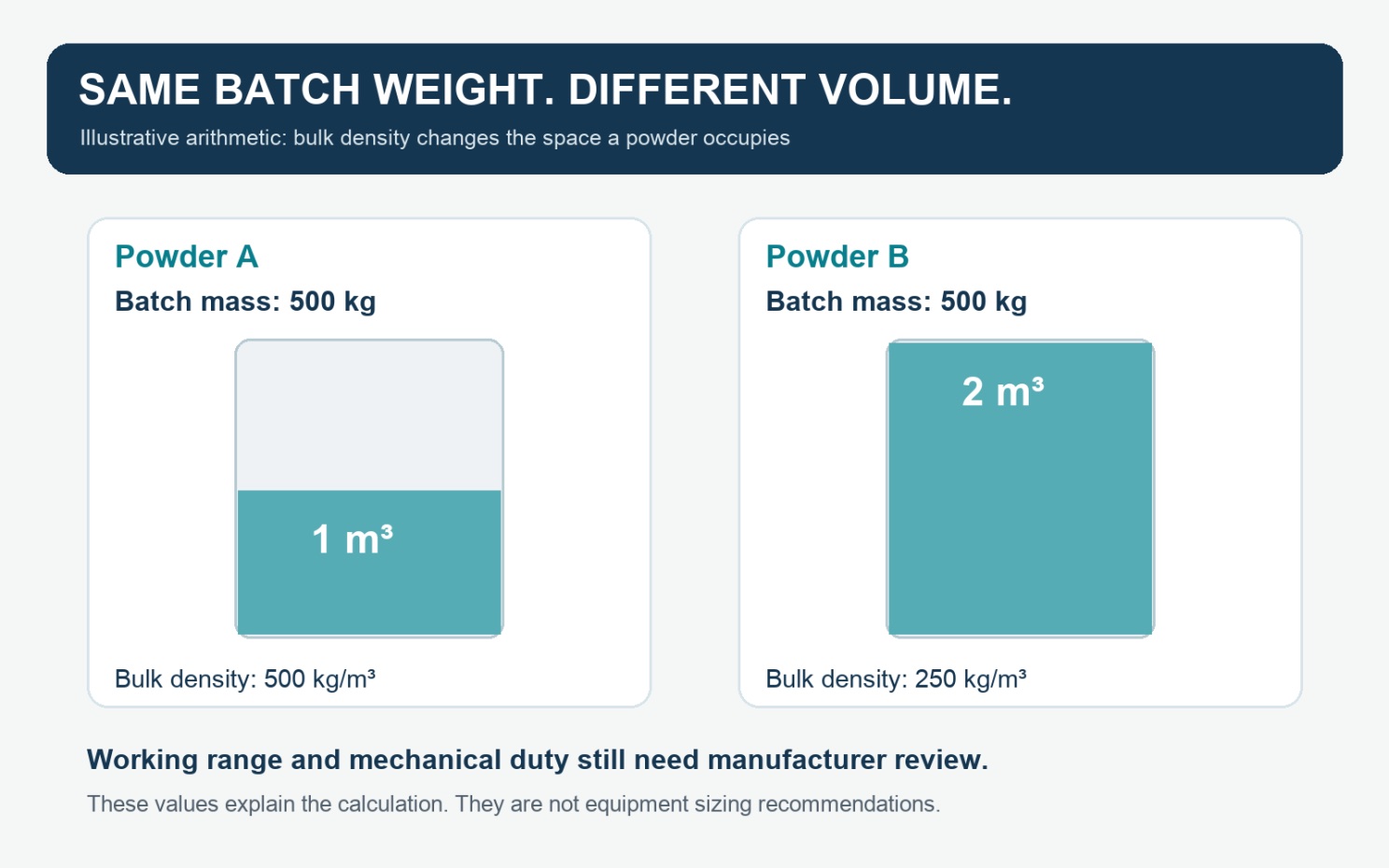
As a simple illustration, a 500-kilogram batch at a loose bulk density of 500 kilograms per cubic metre occupies about one cubic metre. At 250 kilograms per cubic metre, the same batch mass occupies about two cubic metres. These are illustrative arithmetic values, not equipment recommendations.
The required operating space is not necessarily the vessel’s total geometric volume. Confirm the manufacturer’s working-capacity definition and permitted fill range for the actual formulation. ROSS guidance on specifying ribbon blenders distinguishes batch volume from the bulk-density information needed to assess the mechanical duty.
If several products will share the machine, list their minimum and maximum batch masses and densities separately. A single average can conceal the most demanding case.
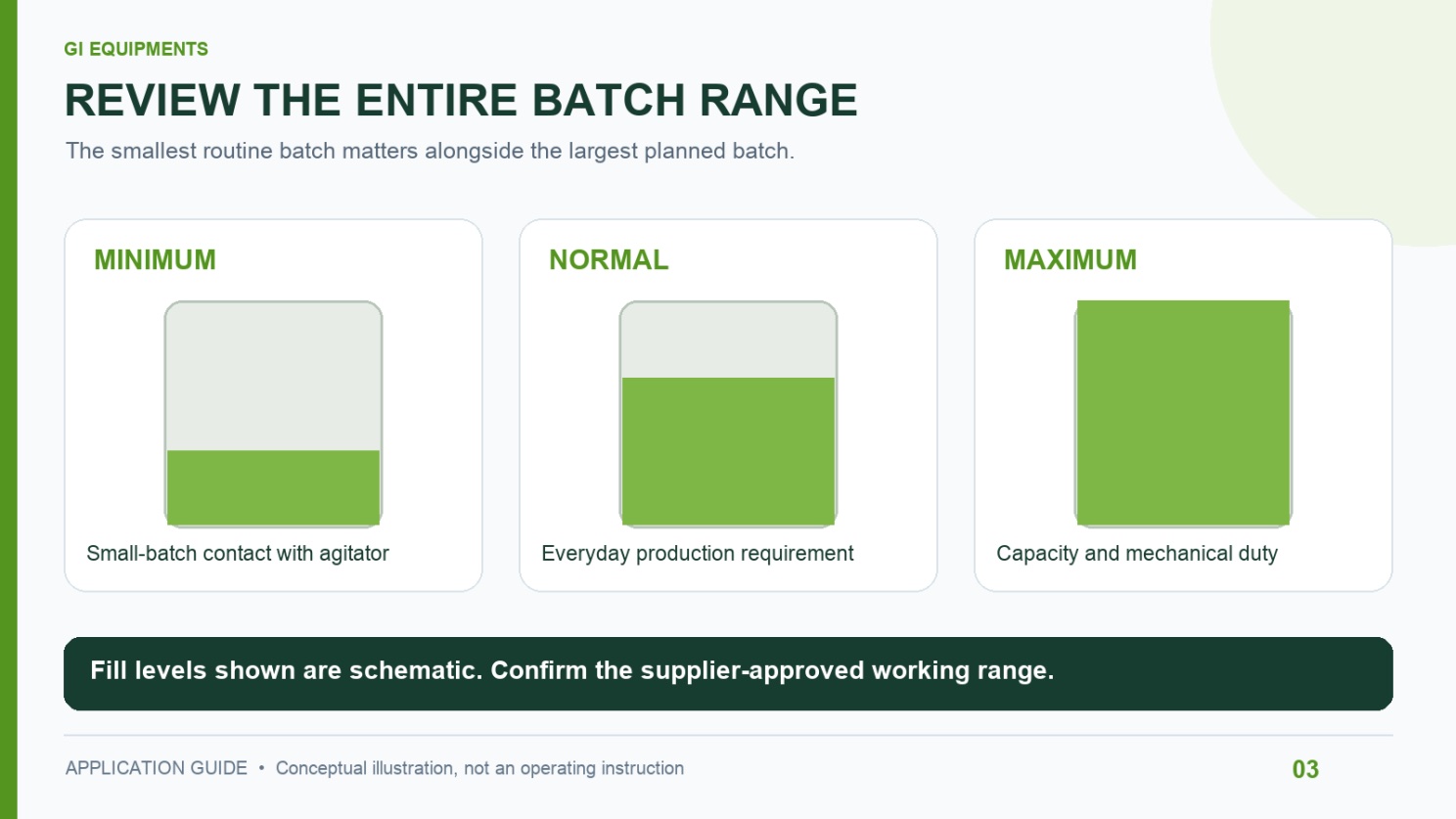
2. Include the smallest batch, not just the largest
A future expansion plan often encourages buyers to choose a larger machine. That may be reasonable, but only if today’s batches can be processed within its approved operating range.
Ask the supplier to assess the smallest routine batch as well as the maximum. A vessel with spare capacity is not automatically able to blend every smaller quantity satisfactorily. The material must interact with the intended agitator arrangement.
Do not adopt a universal fill percentage from an unrelated machine. Obtain the offered unit’s recommended working range and, where performance is important, confirm it through a suitable trial. Record whether that range is expressed against total volume or rated working capacity.
This distinction also helps production planning. A machine that suits the large weekly batch but struggles with frequent small batches may create an operational compromise that a catalogue comparison would miss.
3. Describe powder behaviour in practical terms
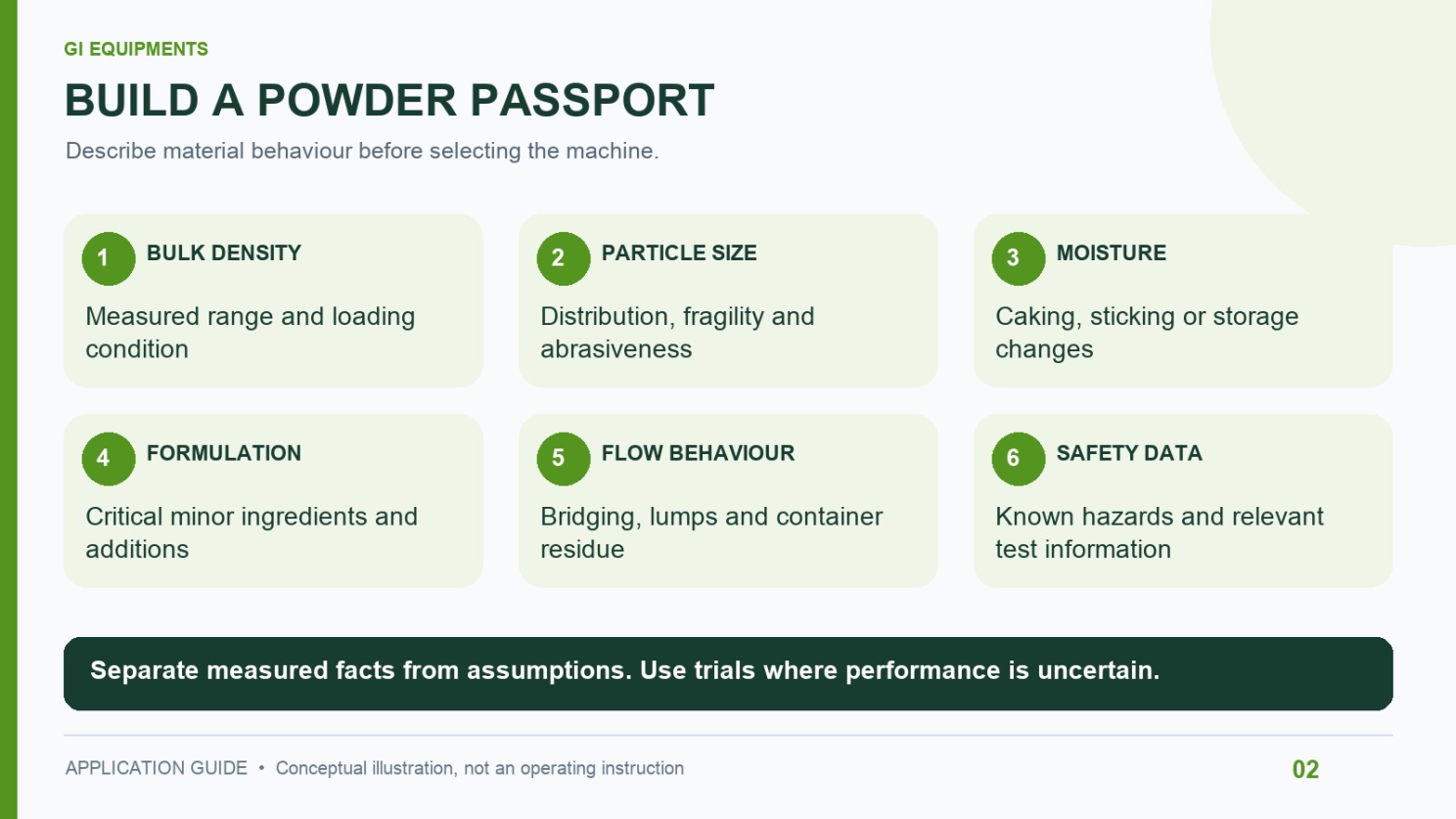
Send more than a material name. Share available information on particle size, bulk density, moisture, flowability, abrasiveness, temperature sensitivity and any tendency to cake or stick. Explain whether the formulation contains a very small proportion of a critical ingredient.
Describe what operators observe. Does the material bridge during charging? Does it form lumps after storage? Does it cling to containers? Such observations do not replace testing, but they help identify useful questions for a trial.
For a new recipe, separate known data from expected behaviour. A supplier should not have to treat an untested assumption as a confirmed design input. Samples and a written formulation range can help the engineering team understand the intended duty without exposing unnecessary proprietary detail.
Where confidentiality matters, agree how samples and technical information will be handled before sharing them.
4. Define blend quality before deciding mixing time
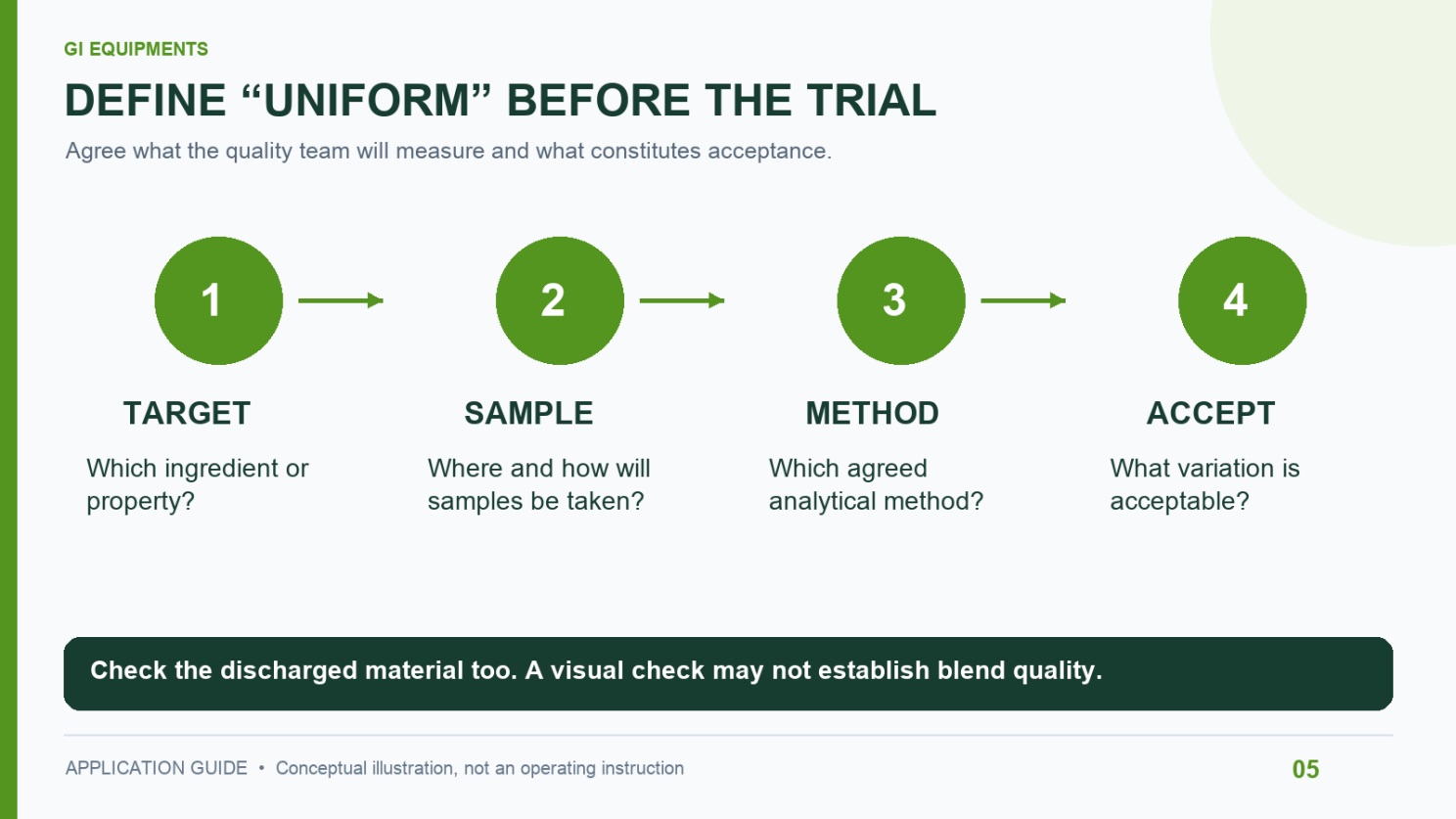
“Uniform mixing” needs a measurable meaning. Which ingredient or property will indicate uniformity? Where will samples be taken? What variation is acceptable? Who will approve the result?
These questions should be agreed by the production and quality teams. A visual check may be inadequate when the critical component is present at a low concentration or is not visibly different from the rest of the mixture.
A practical trial should record the formulation, charge quantity, loading sequence, operating conditions, sample locations and analytical method. It should also consider the discharged material, because a satisfactory sample from inside the blender does not by itself describe what reaches the next process.
Mixing time should emerge from a validated process, not become an unsupported promise in the purchase order. For different products, the appropriate cycle may differ.
5. Review the complete cycle
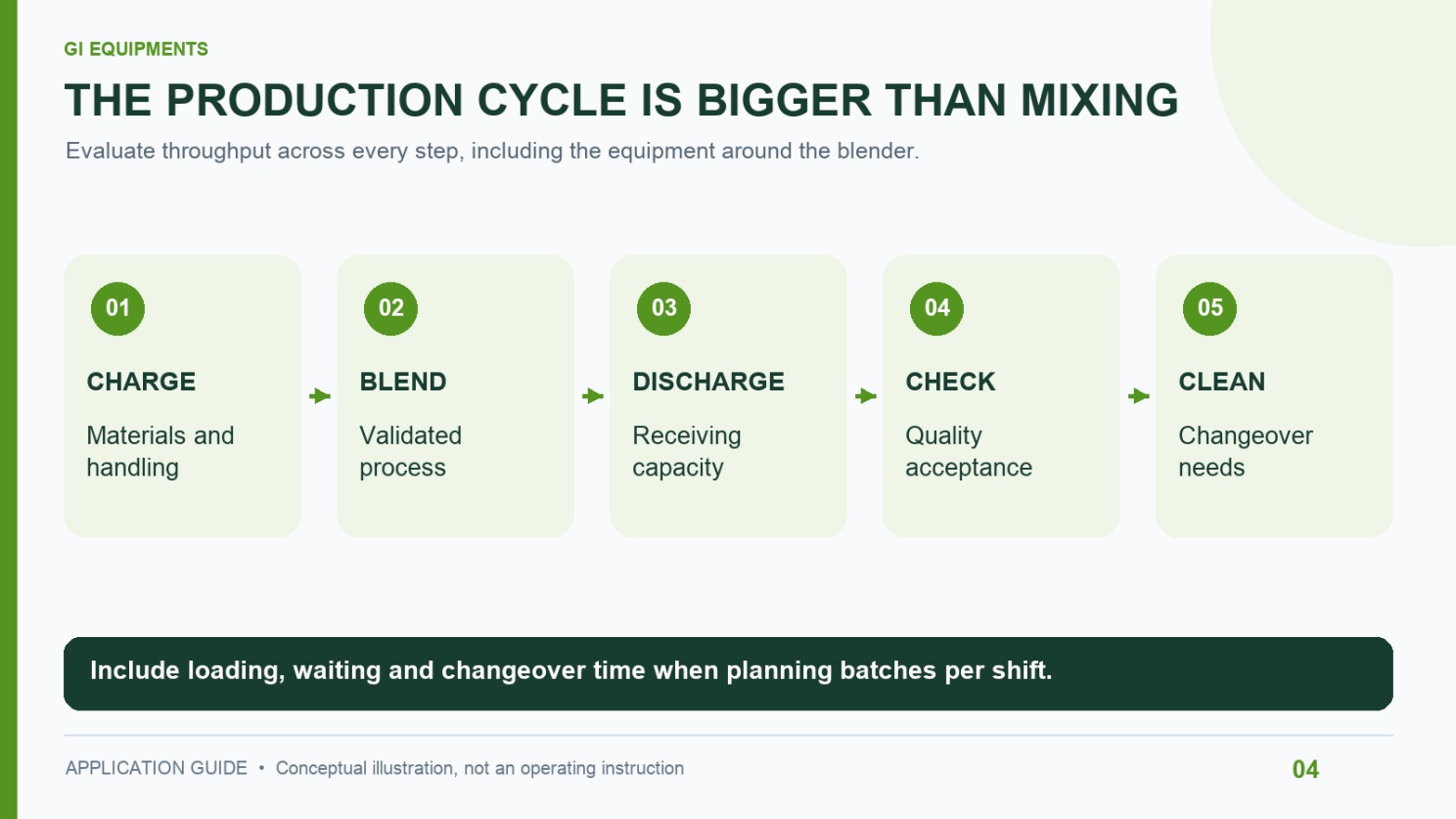
The advertised mixing period is only one part of production time. A realistic cycle includes charging, any staged additions, blending, discharge, inspection and cleaning where required.
Write down the target batches per shift and the available working hours. Then examine the steps around the machine. Can bags be loaded safely? Is the discharge height compatible with the receiving container? Does the next process have enough capacity to accept the batch?
A larger motor cannot solve a slow bag-handling arrangement or an undersized downstream receiver. A layout review can reveal these issues before fabrication, when changes are generally easier to coordinate.
Include the operators in that review. They will notice awkward access, difficult lifting and hard-to-reach cleaning areas that may not be obvious in a capacity table.
6. Match the drive and structure to the duty
Motor selection, gearbox selection, shaft design and agitator construction are related decisions. A change in product density or operating duty should be reviewed as an engineering change, not handled by replacing the motor in isolation.
ROSS’s operating guidance specifically cautions against fitting a larger motor to accommodate a denser product without consulting the manufacturer. The existing agitator and supporting components may not be designed for the resulting loads.
In a new enquiry, explain the intended start-and-stop pattern and whether the machine will start with material already loaded. Ask the supplier to state the offered duty and operating limitations. Any variable-speed arrangement should have a defined operating range and purpose.
The useful question is not “How many horsepower can we get?” It is “What mechanical arrangement is appropriate for this material, batch and operating pattern?”
7. Make cleaning and containment part of the specification
Specify product-contact materials and finish requirements according to the application. Review the trough, agitator, seals, discharge valve and any addition points together. Where product changeovers are frequent, ask how residue will be inspected and removed.
A food, pharmaceutical or chemical application may bring specific hygiene, contamination-control or compatibility requirements. Do not assume that a stainless-steel construction alone establishes compliance. The purchaser and supplier should agree the relevant design and documentation requirements.
Containment also needs attention during loading and discharge. Identify the available dust-extraction arrangement, enclosure requirements and cleaning method. Avoid treating housekeeping as an afterthought once the machine is installed.
8. Ask whether the powder presents a combustible-dust hazard
Some powders can create fire or explosion hazards under particular conditions. Material transfer and mixing may also generate static electricity. The US OSHA combustible-dust guidance explains why apparently familiar materials require proper assessment in powder-handling operations.
This is a technical safety reference, not a statement that US rules apply to an Indian installation. The site must determine its own applicable requirements with competent safety and engineering specialists.
Give the supplier the available safety data and relevant test information. Agree who is responsible for hazard assessment, electrical classification, bonding or earthing, ventilation and any required protective systems. Never bypass guards or interlocks to improve access or speed.
Illustrative case: one machine, two different products
Imagine a fictional manufacturer planning to blend a light dry mix and a denser granular formulation in the same machine. Both recipes are ordered by weight. The initial enquiry therefore lists one batch size and asks for a standard quotation.
During technical review, the team discovers that the two batches occupy different volumes and have different minimum production quantities. It revises the enquiry to include the complete range, the desired quality test and the cleaning sequence between products.
The supplier can now evaluate the intended operating window or recommend trials before committing to a design. This scenario demonstrates a better specification process; it is not a GI Equipments customer case study or a performance claim.
What to send with a ribbon-blender enquiry
- Material descriptions and available safety information.
- Bulk-density range and how it was measured.
- Minimum, normal and maximum batch quantities.
- Quality target and proposed sampling method.
- Any liquid additions or temperature requirements.
- Charging, discharge and downstream arrangements.
- Cleaning, containment and product-contact requirements.
- Available space, utilities and maintenance access.
Frequently asked questions
Can a ribbon blender be selected using kilograms alone? No. Batch volume, density and material behaviour are also needed. Ask the supplier to confirm the complete working range.
Will a larger blender always give more flexibility? Not necessarily. It must also accommodate the smallest intended batch and the surrounding process.
Can every powder be handled in the same way? No. Fragility, moisture, flow behaviour and hazards differ. A technical review or trial may be required.
Make the first enquiry useful
A clear process brief helps a fabricator propose equipment that fits the work. It also makes commercial comparisons more meaningful because the competing offers can be assessed against the same assumptions.
Explore GI Equipments’ process-equipment portfolio and share the material, batch and layout information through its official enquiry channel. Start with the powder and the production requirement. Let those facts guide the machine.